



Retention is Prevention: What Lars’s Conversation with Legaski Taught Us About Ski Safety
When skiers talk about binding safety, the conversation almost always focuses on release: Will my binding pop open when I fall so I don’t twist my knee?
While proper release values are critical, there is an equally crucial, and often overlooked, side of the safety equation: binding retention.
CAST Touring co-founder Lars Chickering-Ayers recently sat down with Dr. Greg Louie (host of Legaski and physical therapist for mountain athletes) to discuss the biomechanics of ski injuries, mountain longevity, and why reliable binding retention is one of the single most important factors in protecting your joints over a lifetime of skiing.
Here is a dive into the key insights from Lars and Greg’s conversation, and why true retention is the foundation of long-term ski safety.

Binding retention keeps your boot securely in the binding through the forces of skiing.
The Danger of Unintended Pre-Release
An unintended pre-release (when your boot pops out of the ski during normal, hard skiing) is one of the most violent and dangerous events a skier can experience.
When a binding releases prematurely at high speeds, through choppy snow, or in a steep couloir, the skier immediately loses balance and control. This frequently leads to high-velocity, asymmetric impacts, severe knee blowouts (such as ACL/MCL tears), concussions, or spinal trauma.
As Dr. Greg Louie points out from a physical therapy perspective, preventing catastrophic knee injuries isn't just about how you train in the gym, it’s about eliminating unpredictable joint loading on snow. When your equipment performs predictably, your body stays in a biomechanically stable position.
Elasticity: The Heart of Binding Retention
So what actually creates good retention? The answer comes down to elastic travel.
Elasticity refers to a binding’s ability to allow the boot to move laterally or vertically away from the center point during micro-impacts (chatter, compression, snow ruts) and quickly re-center without releasing.
-
Low Elasticity: The binding rigidifies or spikes in tension under quick impacts, forcing an immediate pre-release or sending peak shock forces directly into your lower leg.
-
High Elasticity: The binding absorbs vibration, dampens impact, and pulls your boot back to center in milliseconds, keeping you attached to your ski through aggressive turns and variable snow.
Standard alpine bindings (like the Look Pivot interface used in the CAST Freetour system) feature up to 28mm of lateral elastic travel at the toe, absorbing massive forces before release mechanics ever engage.

Pictured is our in-house WINTERSTEIGER Safetronic machine, the industry standard for testing binding retention. Our products are rigorously tested to ensure you’re getting the safest, highest-performing binding possible.
The Backcountry Dilemma: Tech Pin Toes vs. Alpine Retention
For years, backcountry touring required a dangerous safety compromise. Pin-tech touring bindings are light and efficient on the uphill, but offer virtually zero lateral elasticity on the downhill.
To prevent pin toes from chattering open during aggressive downhill turns or on hardpack, many skiers resort to locking out their tech toe levers. Locking out a pin toe locks the release mechanism completely; meaning if you crash, the ski will not release at all, putting your knees and legs at extreme risk.
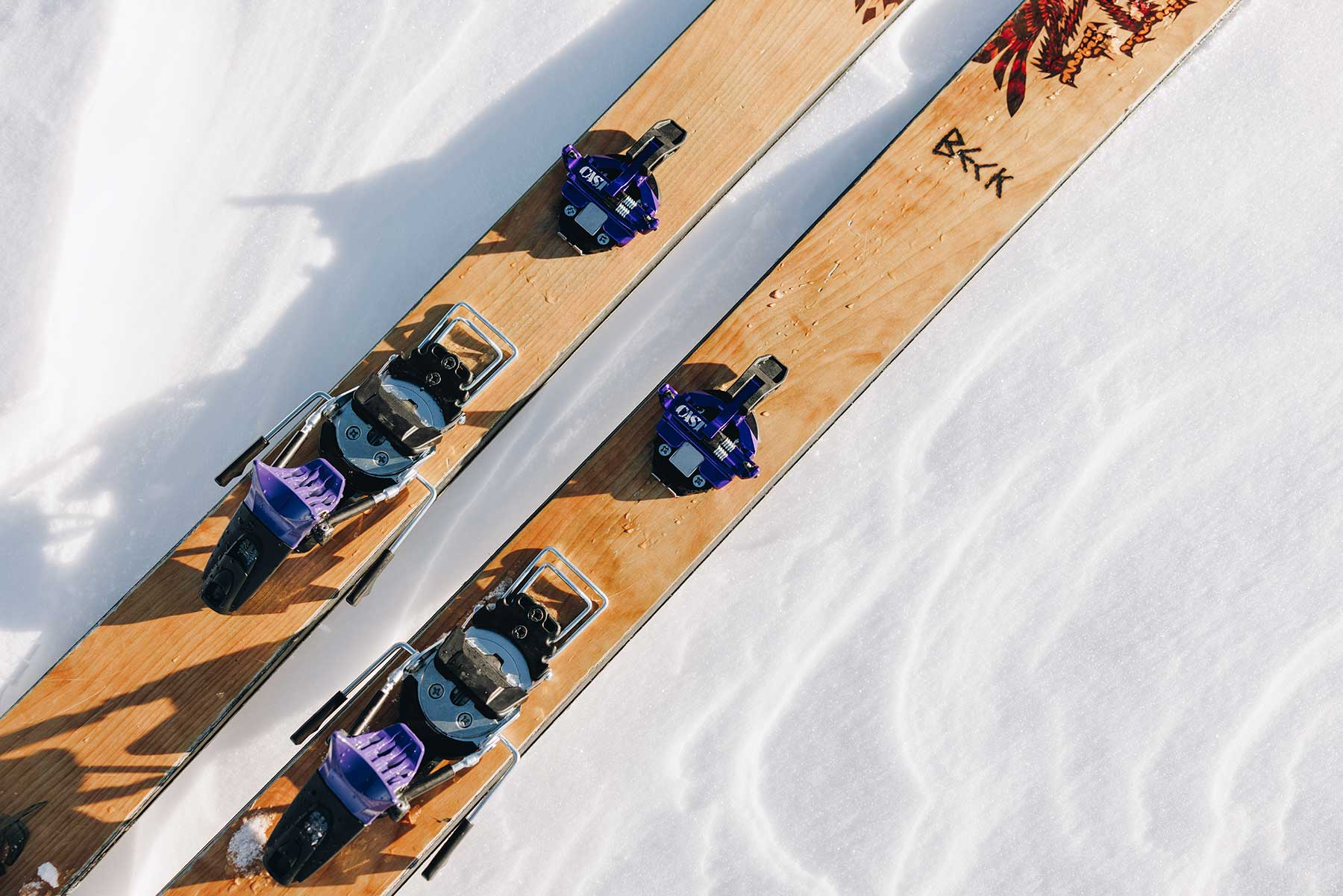
This dilemma was the core motivation behind creating the CAST Freetour System:
-
Uphill Efficiency: Use pin tech toes for weightless, friction-free skinning.
-
Downhill Reliability: Swap to a full alpine toe piece (with true elastic travel and certified alpine retention) before dropping in.
By giving backcountry skiers full alpine retention on the descent, the need to sacrifice downhill safety for uphill performance is entirely eliminated.
3 Rules for Long-Term Ski Safety and Joint Longevity
Whether you are charging in-bounds or logging deep backcountry tours, keep these retention principles in mind to protect your body for decades on snow:
1. Prioritize Elastic Travel over DIN Alone
A high DIN setting won't save you from a pre-release if the binding lacks elasticity. Look for binding systems with deep elastic travel that absorb high-frequency chatter without prematurely opening.
2. Never Lock Out Tech Toes on the Descent
Locking out pin toes might prevent pre-release, but it sacrifices release safety entirely. If you find yourself wanting to lock your toes going downhill, it's a sign your binding system isn't delivering the downhill retention you need.
3. Maintain Your Boot-to-Binding Interface
Snow buildup under boot soles, worn AFDs (Anti-Friction Devices), or rounded boot toes drastically reduce elasticity and throw off both retention and release calibration. Keep your equipment clean and regularly inspected by a certified technician.
Final Thoughts
Long-term ski safety is all about control. When you trust that your skis will stay attached through high-G turns, crusty snow, and/or heavy landings, you ski with greater fluidity, confidence, and physical ease.
Special thanks to Greg from Legaski for bringing biomechanics and physical longevity into the equipment safety conversation!
Listen to the full episode here [link]