



Born on the Tour: Why Performance and Safety Dictated the Hybrid Touring Binding Evolution
In the world of big mountain skiing, "good enough" gear can have dire consequences. When you’re staring down the mountain, be it your favorite local zone, sidecountry terrain, in-bounds double black, or deep in the backcountry, you aren't thinking about weight savings. You’re thinking about performance. You’re thinking about safety.
The "hybrid" alpine touring binding category wasn't born in a boardroom, it was forged in the competitive fires of the Freeride World Tour (FWT) by CAST founders Lars and Silas Chickering-Ayers.
Here is a rundown of why the hybrid binding, specifically the CAST Freetour 2.0 came to be, and why performance and safety are the metrics that truly matter when you're descending in any form of steep terrain.
The Problem: The "Pre-Release" Nightmare
Before hybrid bindings, backcountry skiers had essentially two, maybe three, choices:
-
Tech (Pin) Bindings: Incredible for going up, but notoriously binary on the way down. They are either locked (dangerous for your knees and avalanche safety) or risked pre-release when subjected to the high-impact forces of aggressive skiing.
-
Frame Bindings: Safe for the down, but heavy, clunky, and prone to breaking under the leverage of a wide ski.
-
Telemark: The original tech for touring, mad respect, but for our purposes as alpine skiers, it’s not really an option.
For Lars and Silas, none were acceptable. While training to compete on the world stage, they needed a binding that provided the elastic travel of a world-class alpine toe with the uphill efficiency of a tech toe or pin system. Simply put: They needed a binding that could climb, reliably stayed on when it should and came off only when it was needed to.
Performance First: The Power of Elasticity
The primary reason hybrid bindings, and specifically the CAST system, were developed was to bring elasticity to the backcountry.
-
What is Elasticity? It’s the binding's ability to absorb a momentary shock (hitting a frozen rut or landing a drop) and "snap" back to center without releasing.
-
The Tech Binding Issue: Traditional pin bindings have almost zero lateral elasticity. If the force exceeds the spring tension for even a millisecond, the boot is gone.
-
The Hybrid Solution: By utilizing an alpine toe piece (like the Look Pivot 15 or 18) for the descent, hybrid systems allow for significant lateral travel. This dampens the ride, reduces "chatter," and provides a level of confidence that pin bindings simply cannot match.
Safety: The ISO Standard and Reliable Release
Safety in skiing is defined by predictability. This outline compares the CAST Freetour 2.0 to standard tech binding features.
|
System |
Standard Tech Binding |
CAST Freetour 2.0 w/ Look Pivot |
|
Release Consistency |
Can vary based on boot lug wear and icing. |
Consistent, ISO-certified alpine release. |
|
Vertical Release |
Often simplified at the heel. |
Controlled by the Pivot’s legendary 28mm of elastic travel. |
|
Pre-Release Risk |
High in high-impact or "vibration" scenarios. |
Extremely low; designed for World Cup-level forces. |
Lars and Silas realized that if you want to ski at your best in the backcountry, you can't be forced to dial back your skiing because you don't trust your equipment. Hybrid bindings were created to bridge that trust gap.
The Evolution: From DIY to the Freetour
Skier-innovation led to the birth of the first true hybrid alpine touring in a garage in rural Vermont. The first CAST prototypes were perhaps a bit hacked together, but the concept proved to be effective and has since evolved into the Freetour 2.0 System.
The "Hybrid" label is thrown around a lot these days, but when you’re standing at the top of a high-consequence line, "Hybrid" needs to mean more than just a marketing buzzword. To choose the right one, you have to understand exactly where the engineering compromises were made.

Here is how the category actually breaks down and what you need to consider before mounting your next pair of skis.
1. The "Light" Hybrids: The Weight-Savers
Design: These typically pair a tech (pin) toe with a traditional-looking alpine heel (like the Marker Kingpin, Fritschi Tecton or new AlpenFlow Design).
-
The Difference: You get a more secure heel hold than a pure pin binding, but you are still skiing down on pins in the toe.
-
The Consideration: Because the toe lacks the lateral elasticity of an alpine binding, it can feel harsh on firm snow. The risk of a pre-release from a pin toe during a high-speed chatter or a hard landing is a deal breaker for most big mountain skiers.
-
Best For: Skiers who prioritize uphill speed but want a more consistent release than a pure skimo binding.
2. The "Integrated" Hybrids: The Transformers
Design: These bindings use a single toe piece that transforms from a tech toe to an alpine toe (like the Salomon Shift or Marker Duke PT).
-
The Difference: These offer a true ISO-certified alpine interface for the descent. However, to keep the weight down, they rely heavily on complex plastic linkages and moving parts to handle the transformation.
-
The Consideration: Complexity is the enemy of reliability. These systems can be prone to icing up in the transition or failing, especially under the extreme leverage of a wide ski. They are not meant to withstand aggressive or true big-mountain skiing.
-
Best For: The intermediate to advanced skier who spends half their time in the resort and wants a single-binding solution, but doesn’t demand the high-performance and safety of a modular system.
3. The CAST Approach: The Modular Solution
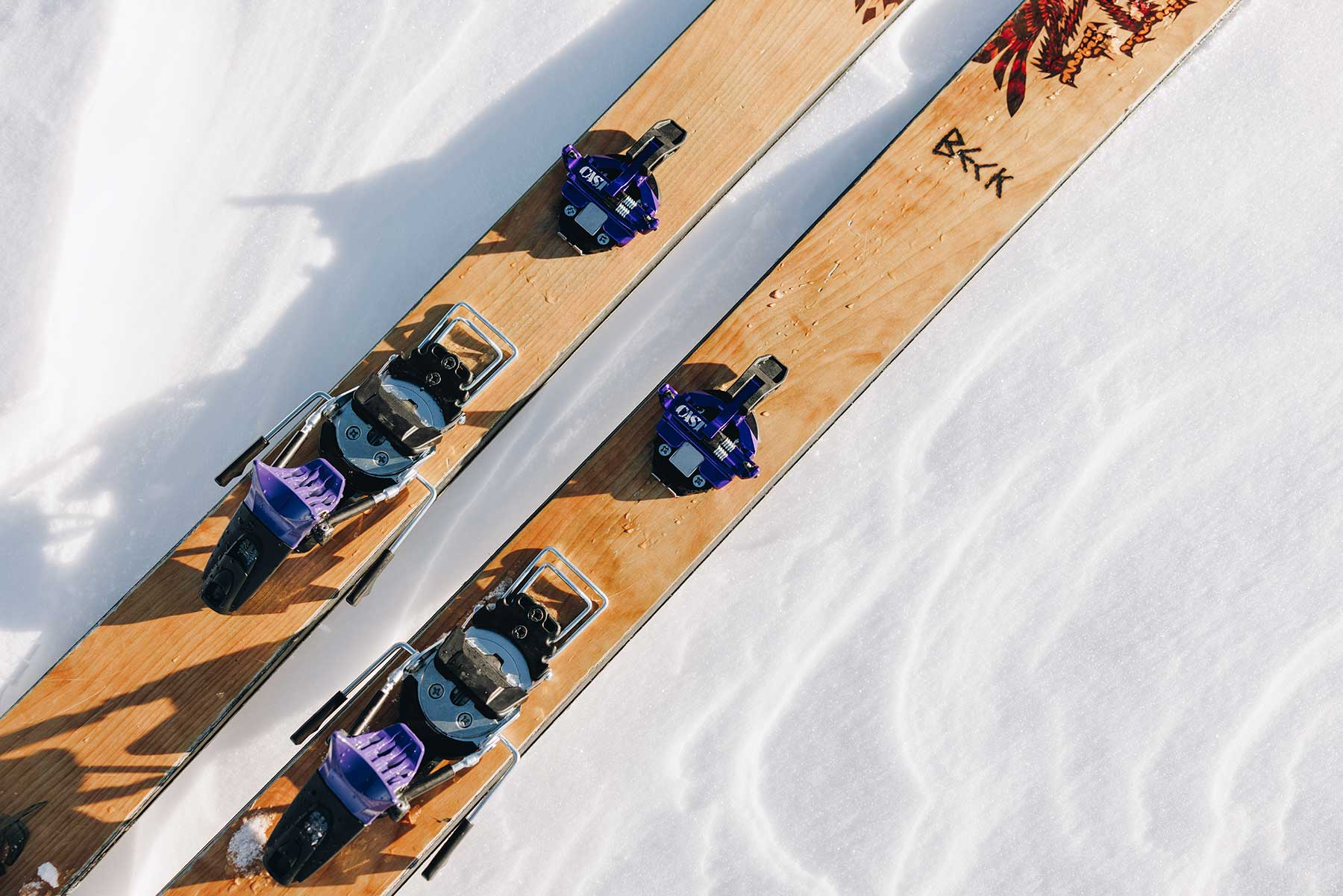
Design: The Freetour 2.0 system is a Modular Hybrid. You use a dedicated, low-weight tech toe for the skin track, then physically swap it for a Look Pivot 15 or 18 toe piece for the descent.
-
The Difference: There is no mimicking here. You are skiing on the most trusted, all-metal alpine binding in history- the Look Pivot. It provides the highest level of lateral elasticity (the ability to absorb impact without popping out) and a signature turntable heel that protects your knees.
-
The Consideration: You have to put the alpine toes in your pack for the climb. While this adds pack weight, it keeps the swing weight on your feet low for the uphill. It is the only system designed specifically to handle the literal forces of big mountain skiing, and the demands of many ski patrollers, guides, and aggressive skiers.
-
Best For: The "Downhill-First" backcountry skier. If your goal is to tour into big terrain and ski it with the same need for performance as you would in-bounds, this is the only zero-compromise option.

Comparison at a Glance
|
Feature |
Light Hybrids |
Integrated Hybrids |
The CAST System |
|
Toe Interface (Down) |
Pins (Tech) |
Alpine Wings |
Look Pivot (Alpine) |
|
Material |
Mostly Composite |
Plastic/Metal Mix |
Solid Steel/Aluminum |
|
Elastic Travel |
Low |
Moderate |
Maximum |
|
Safety Certification |
Partial |
ISO Alpine |
Full ISO Alpine |
|
The "Faff" Factor (time, effort, hassle) |
Low |
Moderate (Flipping Levers) |
Moderate (Swapping Toes) |
Why Hybrid Bindings Matter- Even If You’re Not on the FWT
You don’t need a competition bib to understand the value of a hybrid binding.
A true hybrid binding lets you focus on your line or your job, not on whether your bindings will function as needed. On the mountain, performance and safety are inseparable. One enables the other.
That belief is what created the hybrid category and why CAST continues to define its possibilities.
Click here to learn more and shop the Freetour 2.0
